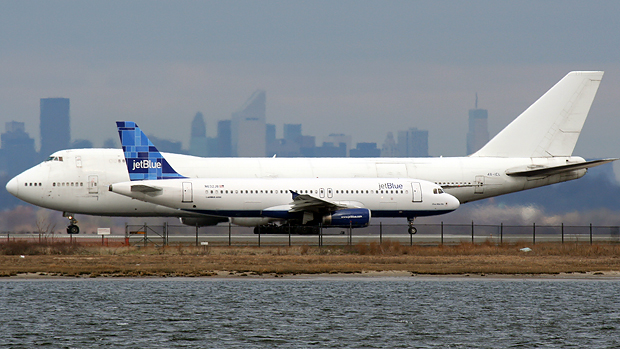
A jetBlue A320 prepares for departure on runway 4L, with a a Cargo Airlines 744F and the Manhatttan skyline in the background. (Photo by Matt Molnar)
| Identifier | FAA: JFK | IATA: JFK | ICAO: KJFK | Airport Diagram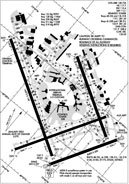 |
|---|---|---|
| Lat/Long | 40-38-23.1040N / 073-46-44.1320W 40-38.385067N / 073-46.735533W 40.6397511 / -73.7789256 (estimated) |
|
| Elevation | 13 ft. / 4.0 m (surveyed) | |
| Variation | 14W (2000) | |
| From city | 13 miles SE of NEW YORK, NY | |
| Time zone | UTC -5 (UTC -4 during Daylight Savings Time) | |
| Zip code | 11430 |
| Airport use | Open to the public |
|---|---|
| Activation date | 01/1939 |
| Sectional chart | New York |
| Control tower | Yes |
| ARTCC | New York Center |
| FSS | New York Flight Service Station |
| NOTAMs facility | JFK (NOTAM-D service available) |
| Attendance | Continuous |
| Wind indicator | Lighted |
| Segmented circle | No |
| Lights | Dusk-Dawn |
| Beacon | White-green (lighted land airport) |
| Landing fee | Yes |
| Fire and rescue | ARFF index E |
| International operations | Customs landing rights airport |
| See JFK Airport Radio Frequencies |
| Runway 13R/31L | |
|---|---|
| Dimensions | 14572 x 150 ft. / 4442 x 46 m |
| Surface | asphalt/concrete/grooved, in good condition |
| Weight bearing capacity | Double wheel: 185.0 Double tandem: 550.0 Dual double tandem: 823.0 |
| Instrument approach | Runway 13R: ILS/DME |
| Runway 31L: ILS/DME | |
| Runway 13L/31R | |
|---|---|
| Dimensions | 10000 x 150 ft. / 3048 x 46 m |
| Surface | asphalt/grooved, in good condition |
| Weight bearing capacity | Double wheel: 185.0 Double tandem: 550.0 Dual double tandem: 823.0 |
| Runway edge lights | high intensity |
| Instrument approach | Runway 13L: ILS/DME |
| Runway 31R: ILS/DME | |
| Runway 4L/22R | |
|---|---|
| Dimensions | 11351 x 150 ft. / 3460 x 46 m |
| Surface | asphalt/concrete/grooved, in good condition |
| Weight bearing capacity | Double wheel: 185.0 Double tandem: 550.0 Dual double tandem: 823.0 |
| Instrument approach | Runway 4L: ILS/DME |
| Runway 22R: ILS/DME | |
| Runway 4R/22L | |
|---|---|
| Dimensions | 8400 x 200 ft. / 2560 x 61 m |
| Weight bearing capacity | Double wheel: 185.0 Double tandem: 550.0 Dual double tandem: 823.0 |
| Instrument approach | Runway 4R: ILS/DME |
| Runway 22L: ILS/DME | |
| Helipad H1 | |
|---|---|
| Dimensions | 60 x 60 ft. / 18 x 18 m |
| Operational restrictions | HELIPORT LOCATED ON TAXIWAY SC ADJACENT TO TWY R |
| Helipad H2 | |
|---|---|
| Dimensions | 60 x 60 ft. / 18 x 18 m |
| Operational restrictions | HELIPORT LOCATED ON TWY EA BTN TWYS A & B. |
| Helipad H3 | |
|---|---|
| Dimensions | 60 x 60 ft. / 18 x 18 m |
| Operational restrictions | HELIPAD LCTD AT BLDG 145 GENERAL AVIATION TERMINAL RAMP. |
| Helipad H3 | |
|---|---|
| Dimensions | 60 x 60 ft. / 18 x 18 m |
| Operational restrictions | HELIPORT LOCATED NW END OF TWY Q ADJACENT TO HANGAR 19. |
| Ownership | Publicly-owned |
|---|---|
| Owner | PORT AUTHORITY OF NY & NJ 225 PARK AVENUE SOUTH 9Th floor NEW YORK, NY 10048 Phone 212-435-3640 LEASEE: PROPERTY OWNED BY CITY OF NEW YORK; BUREAU OF FERRY AND GENERAL AVIATION. |
| Manager | JERRY SPAMPANATO BLDG 14 JAMAICA, NY 11430 Phone 718-244-3501 |
| Terminal | Airlines |
| Terminal 1 | Austrian, Cayman Airways, China Airlines, China Eastern, Japan Airlines, Korean Air, Lufthansa, Olympic, Royal Air Maroc, Saudi Arabian, Turkish |
|---|---|
| Terminals 2 and 3 | Delta, US Helicopter |
| Terminal 4 | Aer Lingus, Aerosvit, Air Europa, Air India, Air Jamaica, Asiana, Avianca, Carbbean, COPA, Czech, Delta, Egypt Air, El Al, Emirates, Etihad, Eurofly, jetBlue, KLM, Kuwait, LACSA, LAN, LOT, North American, Northwest, Pakistan, Royal Jordanian, Singapore, South African, Sun Country, Swiss, TACA, TAM, Thai, Uzbekistan, Virgin America, Virgin Atlantic |
| Terminal 5 | JetBlue |
| Terminal 6 | Vacant |
| Terminal 7 | ANA, British Airways, Cathay Pacific, Iberia, Icelandair, Qantas, United, US Airways |
| Terminal 8 | American, Air Berlin, Finnair, Jet Airways, Mexicana |
| Aer Lingus | A330-200, A330-300 |
|---|---|
| Aeroflot | 767-300ER |
| AeroMexico | 737-800, 767-300ER |
| Air Berlin | A330-200 |
| Air China | 747-400 |
| Air France | A330-200, A340-300, 777-200ER, 777-300ER |
| Air India | 777-200LR |
| Alitalia | 777-200ER |
| American | A300, 737-800, 757-200, 767-200, 767-300, 777-200ER, MD-80, EMB-135/145 |
| ANA | 777-300ER |
| Austrian | 777-200 |
| Asiana | 747-400 |
| Avianca | A319, A320, A330-200, 767-200ER, 767-300ER |
| British Airways | 747-400, 777-200ER |
| Caribbean | 737-800 |
| Cathay Pacific | 777-300ER |
| Cayman | 737-300 |
| China Eastern | A340-600 |
| CSA Czech | A310 |
| Copa | 737-800 |
| Delta | A320, 737-700, 737-800, 757-200, 767-200, 767-200ER, 767-300ER, 767-400ER, 777-200ER, 777-200LR, DC-9, E170, MD-80, CRJ-200, CRJ-700, CRJ-900 |
| EgyptAir | 777-200ER |
| El Al | 747-400, 777-200ER |
| Emirates | A380, 777-300ER |
| Etihad | A340-500 |
| Eurofly | A330-200 |
| Finnair | A330-300, MD-11 |
| Iberia | A340-300, A340-600 |
| Icelandair | 757-200 |
| Japan Airlines | 747-400, 777-300ER |
| Jet Airways | A330-200 |
| JetBlue | A320, E190 |
| KLM | 747-400 |
| Korean | 747-400, 777-300ER |
| Kuwait | 777-200ER |
| LAN | 767-300ER |
| LOT | 767-300ER |
| Lufthansa | A330-300, 747-400 |
| North American | 757-200, 767-300ER |
| Olympic | A340-300 |
| OpenSkies | 757-200 |
| Pakistan | 777-200LR |
| PrivatAir | 737-700 |
| Qantas | 747-400ER |
| Qatar | 777-300ER |
| Royal Jordanian | A340-200 |
| Saudi Arabian | 777-300ER |
| Singapore | 747-400 |
| South African | A340-300 |
| Sun Country | 737-800 |
| Swiss | A330-200, A330-300 |
| TACA | A320, A321 |
| TAM | A330-200 |
| Turkish | A330-200 |
| United Airlines | 757-200 |
| US Airways | A320 |
| US Helicopter | Sikorsky S76 |
| Uzbekistan | 767-300ER |
| Virgin America | A319, A320 |
| Virgin Atlantic | A340-300, A340-600, 747-400 |
| CARGO CARRIERS | |
| Asiana | 747-400F |
| EVA | 747-400F |
| Evergreen | 747-200F |
| FedEx | DC-10F |
| Kalitta | 747-200, 747-400 |
JFK Live Traffic
|
JFK Sectional Chart |

|
John F. Kennedy International Airport is an international airport located in Queens County, New York in southeastern New York City about 12 miles (19 km) from Lower Manhattan. It is the top international air passenger gateway to the United States and is also the leading freight gateway to the country by value of shipments. The airport is operated by the Port Authority of New York and New Jersey, which manages the two other major airports in the New York metropolitan area, Newark Liberty and LaGuardia. JFK airport is the base of operations for JetBlue Airways and is also a major international gateway hub for Delta Air Lines and American Airlines. Around 90 airlines currently operate out of JFK, but this number fluctuates due to seasonal services and the unstable nature of the airline industry. The airport was originally known as Idlewild Airport and it was later renamed “Major General Alexander E. Anderson Airport.” General Anderson was a Queens resident who had commanded a Federalized National Guard unit in the southern United States and who had died in late 1942. (IATA: IDL, ICAO: KIDL, FAA LID: IDL) In 1948, the airport was renamed New York International Airport, though the original name remained in common use. The airport was renamed in 1963 in memory of the late President John F. Kennedy. It is colloquially referred to simply as “Kennedy” or “JFK.” The airport is operated by the Port Authority of New York and New Jersey, under a 1947 lease from the City of New York.[1] The first commercial flight at the airport was on July 1, 1948. The airport was renamed John F. Kennedy International Airport in 1963, one month after the assassination of President John F. Kennedy. The airport received the new IATA airport code of KIA, short for Kennedy International Airport, but as the US death toll in Vietnam became a serious and emotional issue for Americans (“KIA”, short for Killed In Action, was a shorthand in newsreports of US casualties in the war), it was changed in 1968 to JFK, and since then the airport has become widely referred to by the abbreviation “JFK”. The Worldport (Pan Am), now Delta’s Terminal 3, opened in 1962. It featured a large, elliptical roof suspended by 32 sets of radial posts and cables. The roof extended far beyond the base of the terminal and covered the passenger loading area. It was one of the first airline terminals in the world to feature Jetways that connected to the terminal and that could be moved to provide an easy walkway for passengers from the terminal to a docked aircraft, rather than having to board the plane outside via airstairs, which descend from an aircraft, via truck-mounted mobile stairs, or via wheeled stairs. The TWA Flight Center, now jetBlue’s Terminal 5, also opened in 1962. Designed by Eero Saarinen, it was sculpted as an abstract symbol of flight. It is considered one of the most architecturally distinguished airport terminal designs in the world. With the demise of TWA, however, it became vacant. In 2005, JetBlue and the Port Authority financed the construction of a new 26 gate terminal behind the Saarinen building, branded as T5, which opened on October 22, 2008. T5 is the first airline terminal to be designed after the September 11, 2001 attacks, and contains 20 security lanes, one of the largest checkpoints in a US airline terminal. T5 is expected to handle as many as 20 million passengers each year. T5 is connected to the Saarinen building through the original tubes. The Saarinen building is being refurbished and will reopen at a later date as an entry point to T5. Terminal 4 replaced the former International Arrivals Building in May 2001. In 1970, National Airlines opened their Sundrome, designed by Pei Cobb Freed & Partners. It is known as Terminal 6 and is now vacant after JetBlue moved to Terminal 5. As air traffic in New York continued to grow, both Terminal 5 and Terminal 3 were modified in the 1970s to accommodate new Boeing 747s. The supersonic Concorde, operated by Air France and British Airways, provided scheduled trans-Atlantic supersonic service to JFK from 1977 until 2003, when Concorde was retired by both carriers. JFK had the most Concorde operations annually of any airport in the world. The cargo operations at JFK were targeted in the 1978 Lufthansa heist and 1967 Air France robbery, inspiring the Nicholas Pileggi novel Wiseguy and Martin Scorsese film Goodfellas. By the mid-1980s, JFK had overtaken Newark International Airport (now Newark Liberty International Airport) to become New York City’s busiest airport. In 1998, to celebrate the 50th Anniversary of JFK Airport the Port Authority introduced a new airport slogan: “JFK: Where America Greets the World.” Later that year, the airport began construction of the AirTrain JFK rapid transit system. Completed in December 2003, the rail network links each airport terminal to New York City subways and regional commuter trains at Howard Beach and Jamaica, Queens. After the September 11, 2001 attacks, JFK was one of the first airports in the United States to be temporarily closed. On March 19, 2007, JFK became the first airport in the United States to receive the Airbus A380 with passengers aboard. The route-proving flight with more than 500 passengers was operated jointly by Lufthansa and Airbus and arrived at Terminal 1. On August 1, 2008, JFK received the first regularly-scheduled commercial A380 flight to the United States, operated by Emirates on its New York-Dubai route using Terminal 4. |
This page contains excerpts of Wikipedia entry John F. Kennedy International Airport, shared under the GNU Free Documentation License. |